In January 2023, during a brutal cold snap that pushed temperatures to -22°F across parts of northern Minnesota, a postal carrier on a rural route noticed something on the front porch of an abandoned farmhouse that had been vacant for over two years
.
At first she thought it was a pile of old rags frozen to the boards.
She almost kept walking.
When she stepped closer, she saw fur. Then she saw the ears. Then she saw that the animal was not dead, but was so still and so ice-covered that the difference was almost impossible to tell.
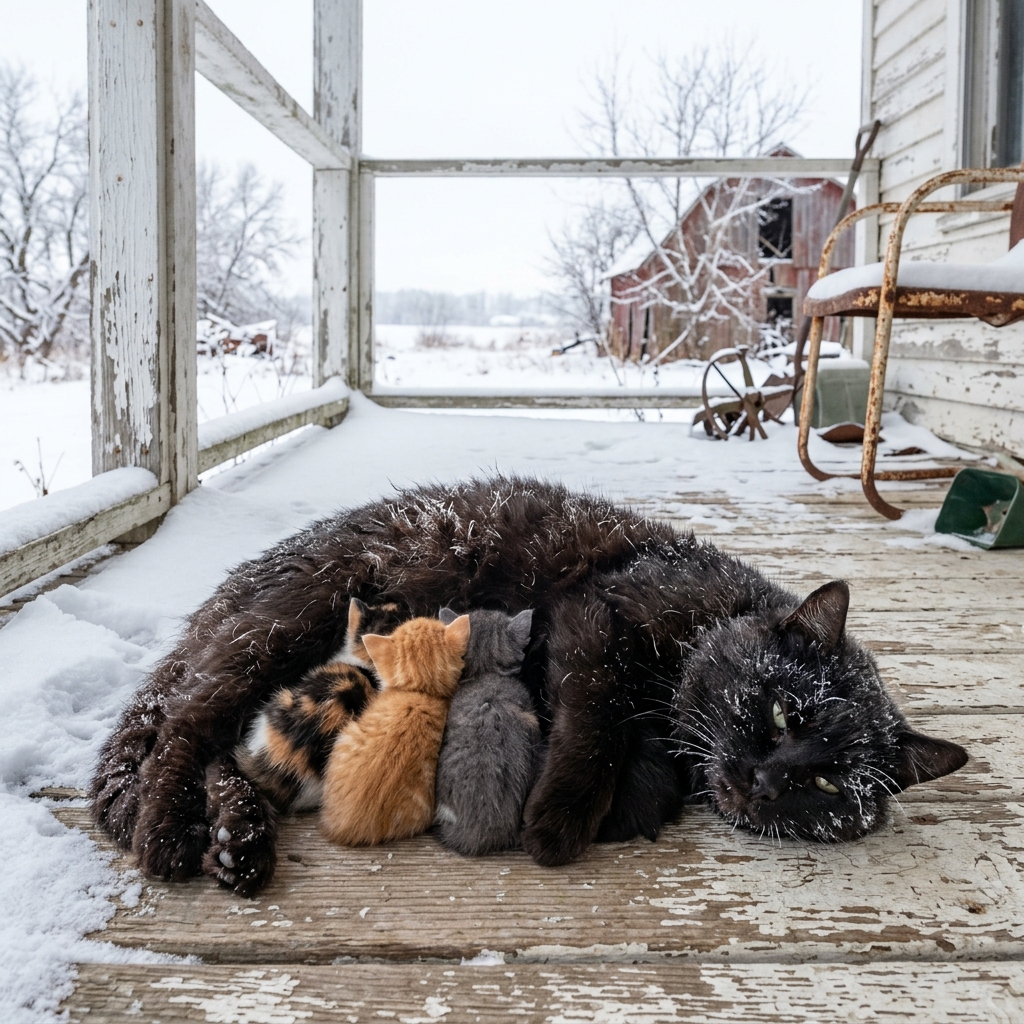
It was a large black tom. Unneutered. Scarred. His left ear was half missing from an old fight wound long healed over. He was coated in a thick crust of ice across his back, shoulders, and the top of his head. His whiskers were frozen rigid. His eyes were open but barely responsive. His breathing was so shallow it was only visible because of a faint pulse of vapor in the frozen air every few seconds.
He was lying flat on his side in a tight curl on the bare wooden porch boards. His body was pressed against the base of the front door where a narrow gap let a thin draft of slightly warmer air escape from inside the house.
She called county animal services. A volunteer drove out within the hour. When they tried to move him, he growled. Not a warning. A plea. His front claws, most of them broken, extended and gripped the porch boards. He would not be lifted.
That’s when the volunteer looked underneath him.
Pressed into the space between his belly and the porch, arranged in a tight cluster against his body heat, were four kittens. They were roughly three to four weeks old. Different colors. Different patterns. They were not his litter. At least two appeared to be from entirely different mothers based on age variation and markings.
Every single one was warm. Every single one was breathing.
He had gathered them.
The volunteer later described the scene to local animal welfare staff. During the worst night of the cold snap, when exposed animals across the county were dying in barns and under vehicles, this cat had found four kittens that had no mother, no shelter, and no chance, and he had covered them with his own body on an open porch in -22°F air for what veterinary estimates suggest was at least fourteen to eighteen hours.
He gave them the heat from his body until he had almost none left for himself.
When they finally separated him from the kittens at the county shelter, his core body temperature was 87°F. Normal for a cat is 101. He was in severe hypothermia. His ear tips—what remained of them—were black with frostbite. The pads of all four paws were white and hard. Three of his toes on his left rear foot would later need to be amputated. The tip of his tail was dead tissue. His kidneys were in early failure from the cold.
The kittens had a core temperature of 98°F.
He had kept them two degrees below normal while his own body dropped fourteen degrees below survival threshold. He was dying in real time, and he did not move.
The shelter veterinarian worked on him for six hours that first night. IV warm fluids. Heated blankets. Slow rewarming to prevent cardiac arrest. He flatlined once during the third hour and was brought back.
He survived.
Recovery took eleven weeks. He lost three toes on the left rear paw. He lost the remaining tip of his damaged left ear. The end of his tail was amputated. His kidneys recovered partially but carry permanent damage that requires daily medication.
All four kittens survived without a single case of frostbite. All four were adopted within a month.
The tom was not adopted for nine weeks. He was large, scarred, missing pieces, and old—estimated at around eight or nine years. He was not the kind of cat people stop for.
A retired firefighter from a small town near the Iowa border drove four hours to get him after reading a short post the shelter had put up with no photo, just a few sentences describing what had happened.
He said one thing to the staff when he arrived.
“That’s the bravest guy I’ve ever heard of and I did thirty-one years on the job.”
The cat’s name is now Captain. He sleeps on a heated bed next to a wood stove. He takes his medication hidden in cheese every morning. He walks with a slight limp from the missing toes.
The firefighter keeps a photo on his fridge of the four kittens the day they were found.
Captain has never seen it.
He doesn’t need to. He already knows what he did.
Thanks for reading this story
SAY YES IF YOU WANT TO READ THE FULL STORY
Please follow us if you like this story