In September 2021, what was left of a weakened tropical system stalled over a rural stretch of the Piedmont region in North Carolina
and dropped eleven inches of rain in under nineteen hours. Creeks that hadn’t flooded in forty years broke their banks before dawn. By noon, water was moving through homes that had never seen a drop inside their walls.
An elderly woman, 74 years old, living alone in a single-story house at the bottom of a low ridge, woke at 4 a.m. to the sound of water already inside her kitchen. By the time she reached the hallway, it was at her ankles. By the time she got to the front door, it was at her knees and rising fast.
She could have walked out then. The road was still passable. A neighbor with a truck was already driving the lane, honking and yelling for people to get out. But she went back inside.
Her cat was in the bedroom. Walter, an eighteen-year-old orange tabby who had been with her since the year her husband died. Walter had kidney disease. He was down to six pounds. He could barely jump onto the couch anymore. He slept twenty hours a day and purred when she carried him to his food bowl every morning because his back legs were too stiff to walk that far on the hardwood.
He was under the bed when the water reached the bedroom. She got down on her hands and knees in the rising floodwater and pulled him out. He was shaking. She wrapped him in a pillowcase to keep him calm and held him against her chest.
By the time she got back to the front door, the water was waist-deep and moving. The neighbor with the truck was gone. The road was gone.
She made it to the front porch. The water continued to rise. She stood on the porch. Then she stood on the porch railing. Then there was nowhere else to go.
A county swift-water rescue team in an inflatable reached her road at approximately 6:30 a.m. They found fourteen people in the first two hours. When they reached her house, only the porch railing and the top of the roof were visible.
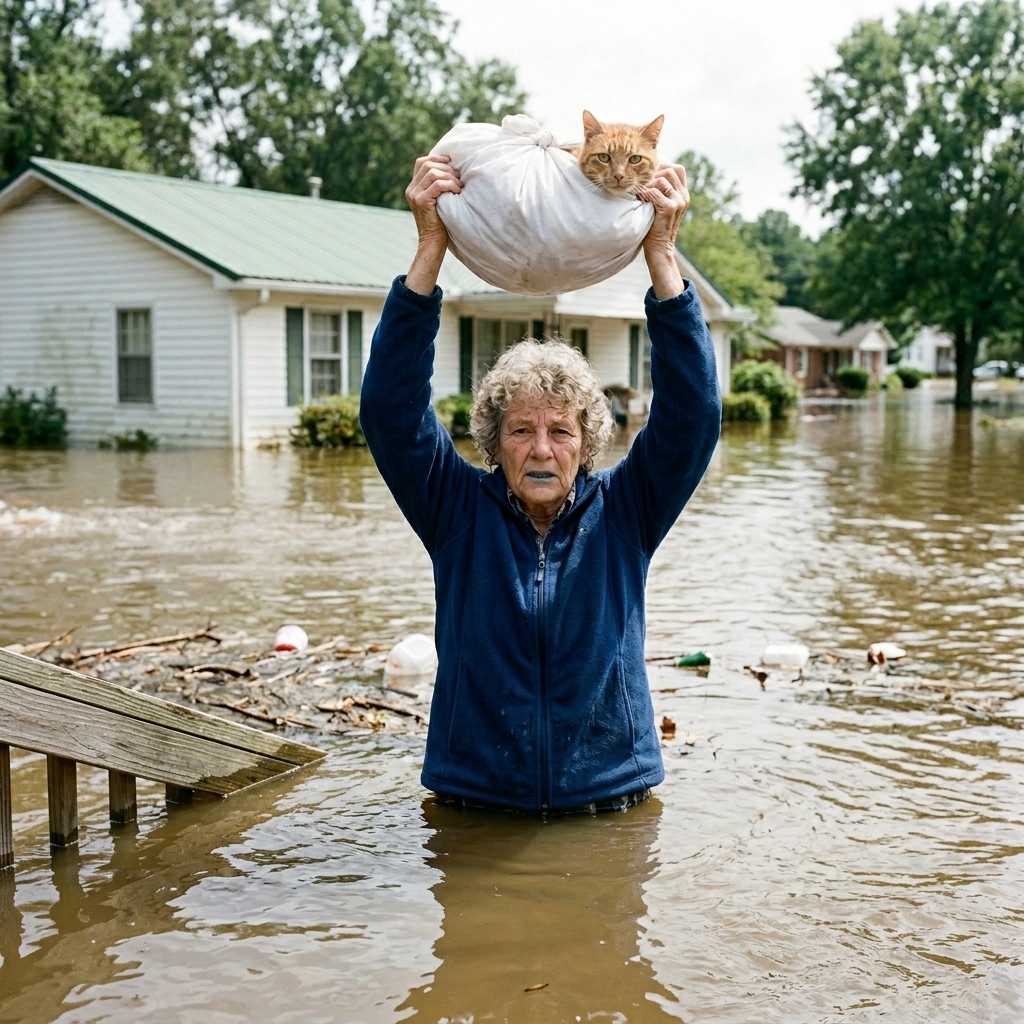
She was standing on the railing, water at her chest, both arms extended fully above her head. In her hands, held as high as her seventy-four-year-old body could reach, was a soaking wet pillowcase with a cat inside it. The pillowcase was above the waterline. She was not.
The water had been at chest height for approximately four hours by then. Her lips were blue. Her arms were trembling so severely that the lead rescuer later said he could see the shaking from thirty feet away. She had been holding a six-pound cat over her head with both arms without putting him down for nearly four hours in moving water in the dark.
She was hypothermic. Her shoulders were later found to have sustained bilateral rotator cuff tears from the sustained overhead strain. Her fingers had to be physically pried open from the pillowcase—the muscles had locked in a grip that her body could no longer voluntarily release.
The first thing the rescue team said to her was that they needed to triage and she would have to let go of the cat so they could get her into the raft.
She said no.
They told her again. She said: “You take him first or you leave us both.”
They took the cat first.
When they opened the pillowcase on the floor of the inflatable raft, Walter was dry from the neck up, breathing normally, and looked up at the rescuer with wide calm eyes. He did not have a scratch. His heart rate was normal. He was warm.
She had held him above the flood with her own body as the anchor.
She spent four days in a hospital being treated for hypothermia, severe muscle damage in both shoulders, and lacerations on her legs from debris in the water she never mentioned and never treated while standing in it.
Walter spent those four days at a temporary animal shelter set up in a church gymnasium. The volunteers said he would not eat. He sat at the front of his crate facing the door for four straight days. He did not turn around. He did not sleep in any position except upright, watching.
When she came to pick him up, she was in a wheelchair. Both arms were in slings. She couldn’t lift him.
A volunteer placed him in her lap.
He put his face into the space between her neck and her shoulder and stayed there for so long that the volunteer had to push the wheelchair to the car because the woman would not move him.
Walter lived for seven more months. He died in his sleep, on her bed, on a Tuesday morning in April. He weighed five and a half pounds. His kidneys had finally failed. She was lying next to him when it happened.
At the small funeral she held for him in her backyard—attended by the neighbor who had tried to evacuate her, two rescue volunteers, and her only living sister—she said just one sentence.
“He waited for me every day of his life. The least I could do was hold him above the water.”
Thanks for reading this story
SAY YES IF YOU WANT TO READ THE FULL STORY
Please follow us if you like this story