The hospice nurse said she had seen thousands of people die
The hospice nurse said she had seen thousands of people die. But in twenty-three years, she had never seen what happened in room 7 on a Tuesday night in March. She quit hospice the next morning. Not because it broke her. Because she said nothing in her career would ever matter as much and she wanted to end on the only thing that ever made dying look like something other than losing.
In March 2024, in a small hospice facility tucked into the rolling farmland outside a quiet town in the Finger Lakes region of upstate New York, a woman was dying.
She was ninety-one years old. She had been a piano teacher for fifty-three years. She had taught over four hundred students in the living room of a farmhouse she and her husband built in 1961. Her husband died in 2009. Her two sons lived out of state — one in Arizona, one in Germany. Neither could arrive in time. They were en route. They would not make it.
She was alone.
She had been in the hospice facility for fourteen days. Her diagnosis was end-stage congestive heart failure. Her body was shutting down in the slow, measurable, predictable way that hospice nurses learn to read like weather — the mottling of the skin on the feet, the changes in breathing patterns, the long pauses between breaths that grow longer each hour. The staff estimated she had less than twenty-four hours.
She was conscious. That was the part that made it hard. She was awake, aware, oriented. She knew where she was. She knew what was happening. She knew her sons weren’t there. She knew she was going to die in a room where nobody who loved her was present.
The hospice nurse assigned to her that night — a woman who had been in end-of-life care for twenty-three years, who had been present for what she estimated was over two thousand deaths — sat with her for a while after her evening rounds. She held the woman’s hand. She told her she wouldn’t be alone. She meant it the way hospice nurses always mean it — professionally, compassionately, genuinely. But they both knew the difference between a kind stranger and a person who has known you for a lifetime.
The woman said one thing to the nurse that evening. Her voice was thin, barely above a whisper, but clear.
She said: “I can hear all of them. Every student. Every song they ever played badly.”
She smiled.
Then she said: “I wish Simon were here.”
The nurse assumed Simon was one of her sons. She checked the chart. Neither son was named Simon. She asked gently: “Who is Simon?”
The woman closed her eyes. “My cat. He’s at the house. My neighbor is feeding him. He’s probably sitting on the piano.”
She paused.
“He always sat on the piano when I played. Every lesson. Every student. Fourteen years. He just sat there and listened. Never moved. Never bothered anyone. He just listened.”
Another pause. Longer.
“I’d like to hear him purr one more time. That’s all. I don’t need anything else. I just want to hear him purr.”
The nurse finished her rounds. She charted her notes. She did everything she was supposed to do. Then she did something she was not supposed to do.
She called the neighbor.
At 9:47 p.m. on a Tuesday night in March, a hospice nurse called a phone number she found in the patient’s personal belongings file and asked a stranger to bring a cat to a dying woman’s bedside.
The neighbor — a retired school bus driver, seventy years old, who had been feeding the cat for two weeks — didn’t hesitate. Not for one second. She put on her coat, picked up the cat, put him in a cardboard box lined with one of the woman’s sweaters from the farmhouse, and drove twenty-two minutes to the hospice facility.
She arrived at 10:35 p.m.
The facility did not have a pet visitation policy. There was no protocol for this. The night administrator could have said no. Should have said no, by the rules. The nurse met the neighbor at the side entrance. The administrator was doing paperwork in the back office. Nobody asked permission.
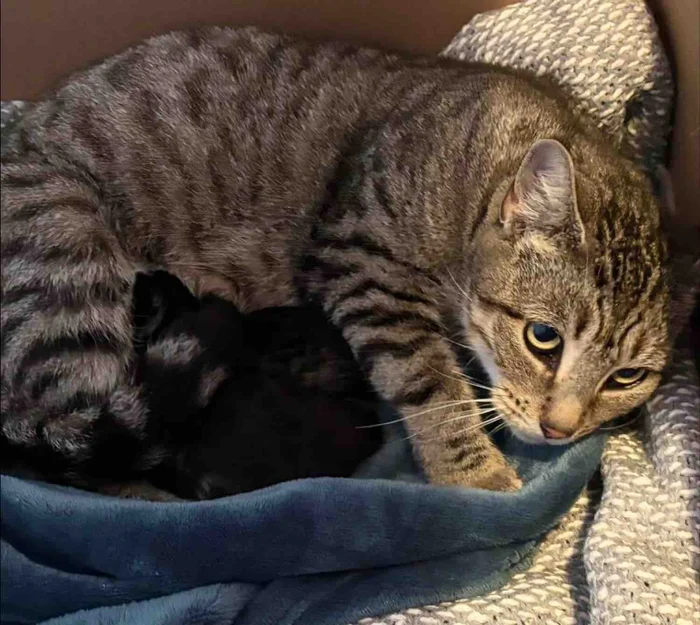
The cat was a large, fourteen-year-old silver tabby — classic mackerel pattern, heavy-boned, approximately fifteen pounds. He had a broad, dignified face with long white whiskers that curved downward. His eyes were a deep amber-gold. He moved slowly — the careful, deliberate movement of an old cat who had learned that the world was not in a hurry and neither was he.
The neighbor placed him on the bed. He had not been in this building before. He had not seen this room. He had not been near this woman in fourteen days.
He walked up the bed. Slowly. Paw over paw. The sheets rustled. The heart monitor beeped its slow rhythm. The oxygen concentrator hummed.
He walked to the woman’s chest. He laid down. He positioned himself exactly the way the woman described — the piano position. The position he took during every lesson for fourteen years. Upright at first, front paws tucked, sitting on her upper abdomen facing forward. Then, slowly, he lowered himself flat against her chest, his chin resting on his paws, his body settling into her with the heaviness of an old cat who knew how to fit into the space a human body makes when it’s lying still.
The woman’s eyes opened.
She couldn’t lift her hands — she was too weak, her arms hadn’t moved voluntarily in two days. But her fingers moved. The fingers that had taught four hundred students to play piano. They uncurled from the bedsheet and rested against the cat’s side. Not gripping. Not petting. Just touching. Her fingertips on his ribcage. Feeling the vibration.
Because he was purring.
The moment he laid down on her chest, he began purring. Deep. Sustained. The kind of purr you don’t just hear — you feel through furniture, through mattresses, through the bones of a ninety-one-year-old woman’s chest.
Her fingers moved on his ribcage. Very slightly. Very gently. Not random movement — rhythmic movement. Spaced. Deliberate. The nurse watched from the doorway and didn’t understand at first.
The neighbor understood immediately. She put her hand over her mouth.
The woman was playing piano on the cat’s ribs.
Her fingers were moving in patterns — chord shapes, note sequences, muscle memory so deep that her dying body still remembered what fifty-three years of teaching had carved into her hands. She could not lift her arms. She could not speak above a whisper. She could not turn her head. But her fingers remembered Chopin and Bach and simple scales and the first songs she taught every new student and they played them silently on the ribcage of a cat who purred the only accompaniment she would ever need.
The nurse stood in the doorway for a long time. She said later she didn’t move because she understood she was watching something that had nothing to do with her and everything to do with a woman and a cat and fourteen years of music and the way the body remembers what the mind is already releasing.
The woman played for approximately twelve minutes.
Her fingers slowed. The patterns became simpler. Fewer notes. Longer pauses between them. Her breathing changed — the long, slow transition that hospice nurses recognize as the beginning of the final stage. The pauses between breaths grew longer. Five seconds. Eight seconds. Twelve.
The cat did not move. He purred continuously. His amber eyes were half-closed. His body rose and fell with her increasingly shallow breathing. He was perfectly still except for the vibration in his chest — a sound so constant and so deep that the nurse said it filled the room like a low note on an organ that doesn’t stop.
At 11:23 p.m., her fingers stopped moving. Her hand rested flat against his side. Still touching. No longer playing.
At 11:41 p.m., her breathing stopped.
The monitor alarmed. The nurse silenced it.
The cat continued purring.
He purred for forty-seven minutes after she died. The nurse timed it because she couldn’t think of anything else to do and because she felt, in some way she couldn’t explain, that the concert wasn’t over yet and it wasn’t her place to decide when it ended.
He purred on the chest of a dead woman for forty-seven minutes. The same chest that had vibrated with a voice that taught four hundred students to play. The same chest that had just played its final piece on his ribs.
At 12:28 a.m., he stopped purring. He stood up. He stepped off her chest. He walked down the bed, jumped to the floor, and walked to the door of the room.
He sat down and looked at the nurse.
She picked him up. He pressed his head under her chin. She carried him to the neighbor, who was sitting in the hallway on a plastic chair, crying silently.
The neighbor took him home.
The nurse went back to room 7. She stood beside the bed. She looked at the woman’s hands — still positioned on the sheet where the cat had been. Fingers still curved. Still shaped around notes that no longer existed on ribs that were no longer there.
She finished her shift. She filed the paperwork. She drove home as the sun came up over the frozen Finger Lakes.
She submitted her resignation that morning.
Her supervisor called her. Asked why. The nurse said she had thought about it for the entire drive home and the answer was simple.
“I’ve been in hospice for twenty-three years. I have sat with over two thousand people at the end of their lives. I have held hands and wiped foreheads and said ‘you’re not alone’ more times than I can count. I have done everything I was trained to do.”
“Last night I watched a woman play piano on a cat’s ribs while he purred her out of the world. And I realized I have never — not once in twenty-three years — seen anyone die like that. I’ve never seen anyone die playing music. I’ve never seen anyone die touching something that was touching them back. I’ve never seen anyone die with their fingers doing the thing they loved most.”
“I want that to be the last death I attend. I want to end on that. Because if I go back, everything after it will be less. And she deserves to be the last thing I carry.”
“A woman played piano on a cat and he purred and she died and I have never seen anything that beautiful and I never will again.”
The cat went back to the farmhouse. The neighbor continues to care for him. The sons arrived two days later and managed the arrangements. The older son visited the farmhouse and found the cat sitting on the piano bench.
Not on the piano. On the bench. Where she sat. For fifty-three years.
He called his brother in Germany. He said: “The cat is sitting on Mom’s bench.”
His brother said: “Of course he is.”
The piano was donated to the local elementary school. The cat was kept by the neighbor. He is fifteen now. He moves even slower. His amber eyes are cloudier. He sleeps most of the day.
But every evening, at the time the woman used to teach her last lesson of the day, he walks to the neighbor’s living room, sits in the middle of the floor, and purrs.
No one is touching him. No one is near him. He sits alone in an empty room and purrs at the time of day when music used to happen.
The neighbor told the hospice nurse — they stay in touch — that she sits in the kitchen and listens to him purr every evening and she doesn’t go in and she doesn’t interrupt.
“He’s finishing something,” she said. “I don’t know what. But he sounds like he’s finishing something.”
The nurse said: “He is.”
“He’s playing her out.”
Thanks for reading this story SAY YES IF YOU WANT TO READ THE FULL STORY Please follow us if you like this story